Pathway: Designing a Student Development System for High School Guidance
Pathway is an early-stage student development system designed to support reflection and decision-making before high-stakes academic choices occur.
Role: Product Strategy, UX Design, System Architecture
The Problem: Who Gets Missed
High school asks students to make long-term decisions before helping them build the skills needed to make those decisions well.
By the time students are choosing courses, committing to activities, or thinking about college or post-graduation paths, many of those choices are already constrained. Interests were never named. Tradeoffs were never examined. Decisions accumulated quietly, often by default.
Guidance systems are largely designed to respond to visible signals. Students who struggle academically receive intervention. Students who excel receive sustained attention and planning support. A large middle group moves forward without friction, but also without much direction.
These students are rarely in crisis. They meet expectations. They stay on track. As a result, they receive minimal proactive guidance around why they are making certain choices or how those choices connect over time.
When misalignment surfaces, it usually happens late. Counselors hear things like “I’m only doing this because it was expected” or “I don’t really know what I’m interested in.” At that point, flexibility is limited and conversations shift from exploration to course correction.
This is not a motivation problem. It is a development problem.
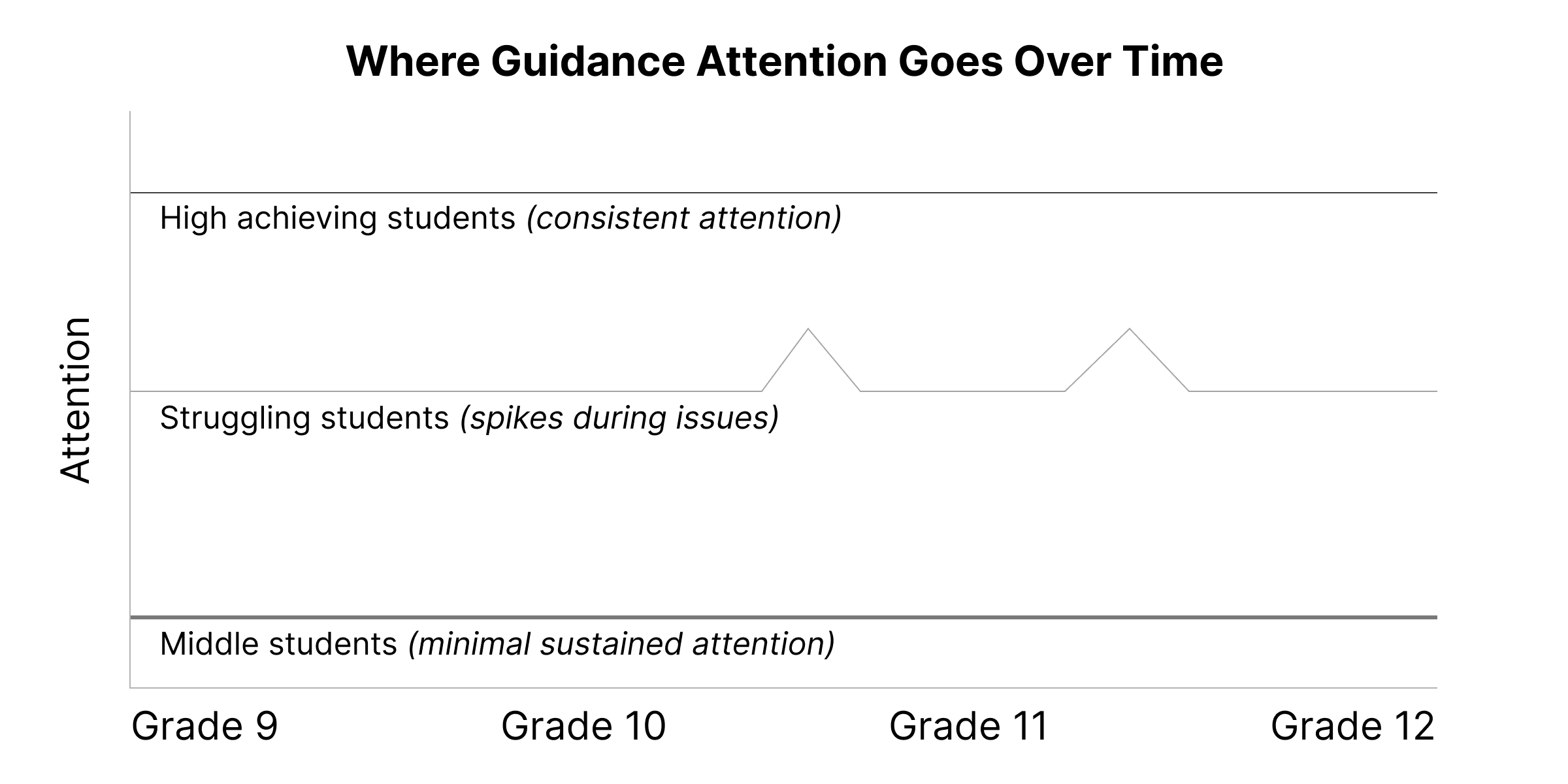
Pathway began as an attempt to design for this gap by supporting student development earlier, when reflection is low-stakes and decisions are still flexible.
Design Principles
These principles guided the structure and sequencing of Pathway. They reflect deliberate tradeoffs rather than abstract ideals.
Design for development, not outcomes
Pathway does not optimize for test scores, college admissions, or performance metrics. It focuses on helping students build the underlying skills required to make decisions they understand and can explain, before stakes are high.
Sequence before scale
Information delivered at the wrong time creates anxiety and shallow decisions. Milestones are sequenced based on developmental readiness rather than institutional timelines, delaying high-stakes planning until students have language for themselves.
Treat reflection as persistent data
Student reflections are not one-off exercises. They accumulate over time and are revisited as context for future decisions. This allows insight to compound rather than reset each year.
Use AI to support reasoning, not replace it
AI is intentionally constrained. It reflects patterns, asks contextual questions, and surfaces inconsistencies, but does not recommend paths or make decisions on a student’s behalf.
Shift effort earlier to reduce downstream pressure
The system is designed to do more work before guidance meetings occur. This allows conversations to start with shared context instead of information gathering, reducing last-minute course correction.
System Overview
Pathway is structured as a longitudinal system rather than a collection of features.
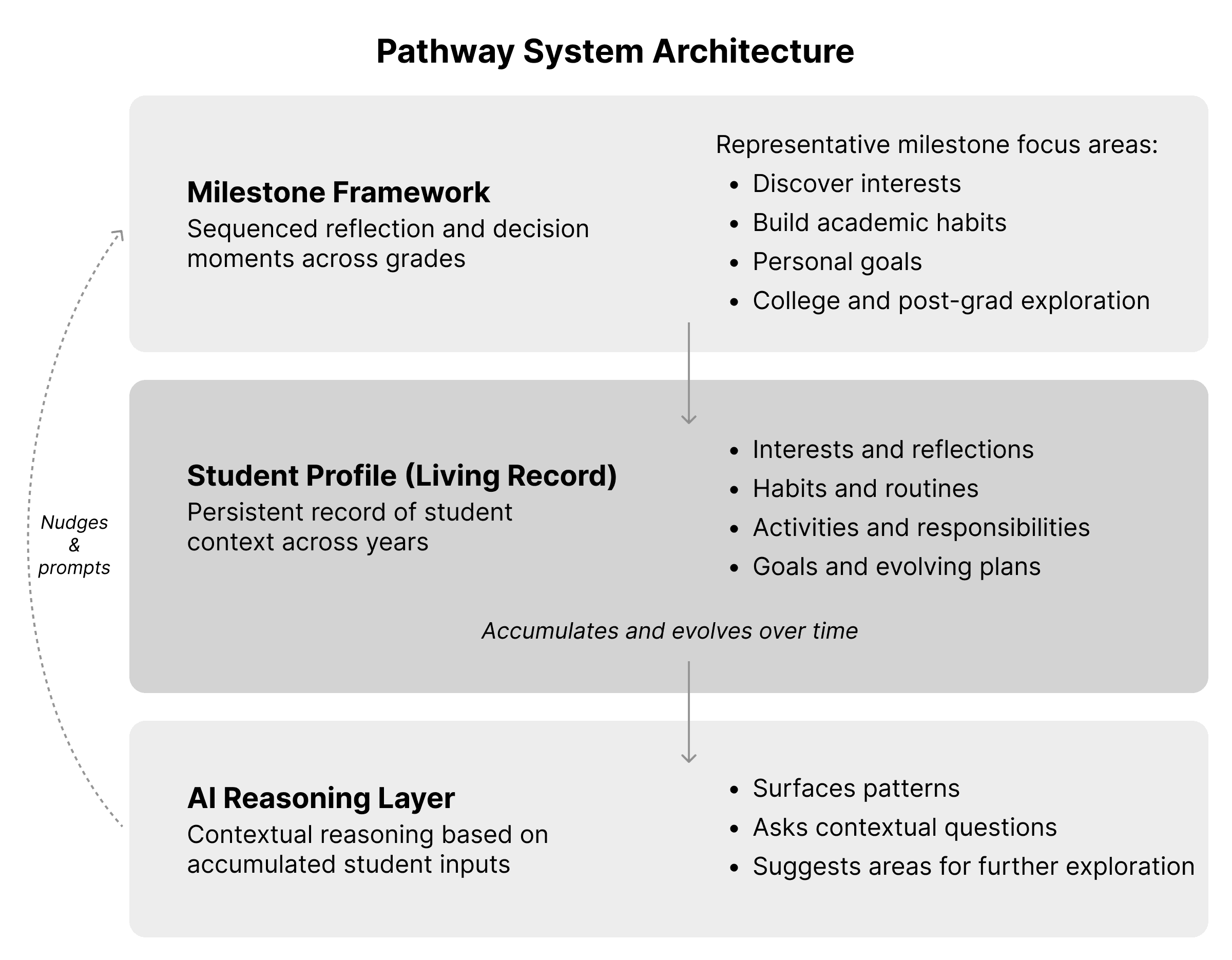
At its core are three connected layers: a milestone framework, a persistent student profile, and a contextual AI reasoning layer. Each layer supports development over time instead of one-off interactions.
Milestones define moments where students are asked to reflect or make decisions. The student profile acts as the system’s memory, accumulating context across years. AI operates on top of this context to support reasoning without overriding student or counselor judgment.
This structure allows guidance conversations to build on prior thinking rather than start from scratch, and it creates continuity across grades without forcing linear progress.
From System to Interface
Pathway’s interface translates its underlying system into a calm, legible experience for students navigating uncertainty over time.
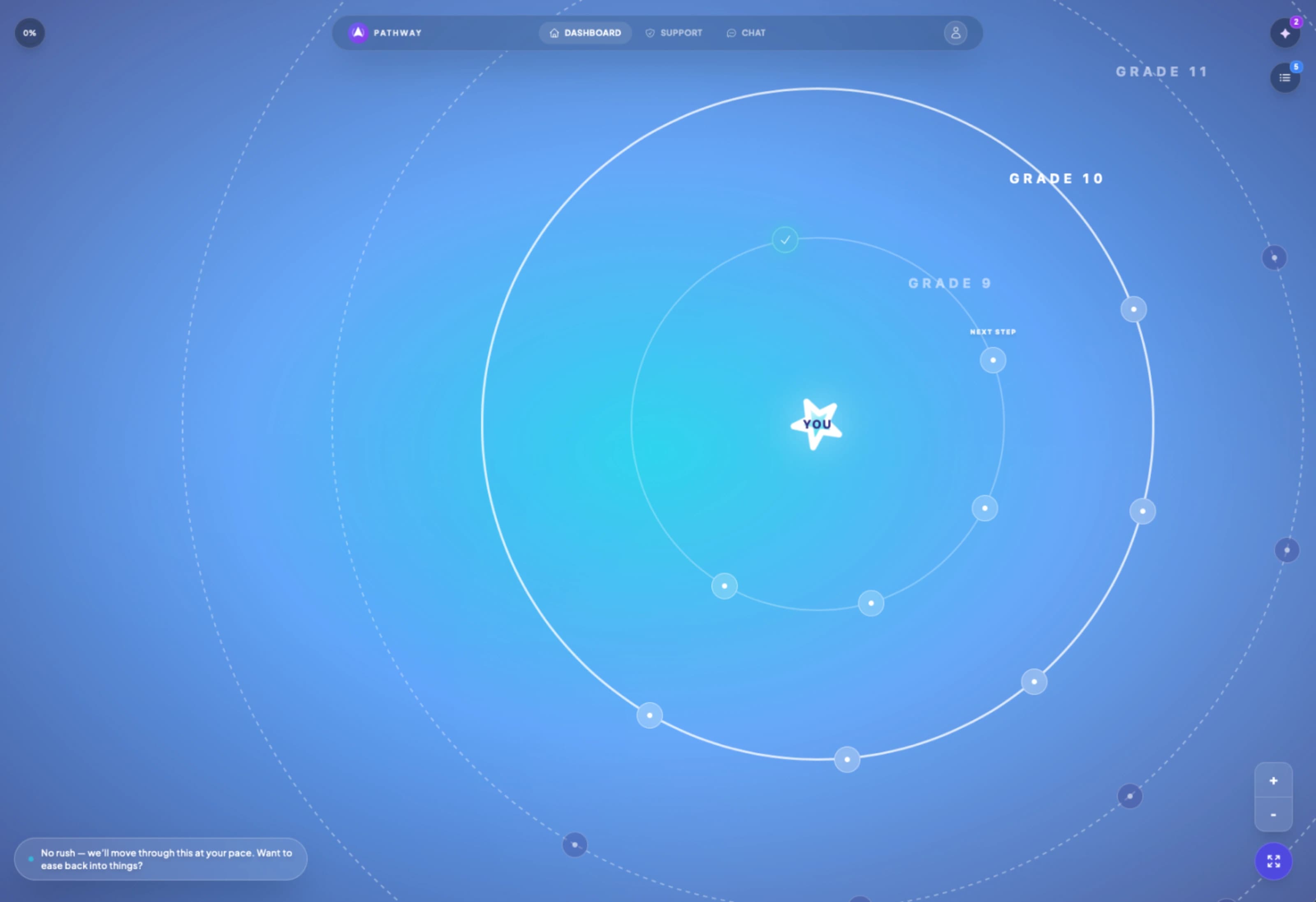
This view centers the student’s current context while keeping past reflection and future milestones visible without demanding action. Progress is expressed spatially rather than sequentially, reinforcing that revisiting earlier thinking is expected, not corrective.
The interface prioritizes orientation, reflection, and continuity over task completion. Its role is to support thinking in motion, not to rush students toward outcomes before they are ready.
Deep Dive: The Milestone Model
The milestone model reframes guidance around moments where students are implicitly asked to make decisions, rather than tasks to complete.
A milestone only qualifies if it maps to a real student decision. Naming interests. Building habits. Choosing whether to deepen involvement. If a step did not clearly support student reasoning, it was excluded.
Milestones are sequenced across grades based on developmental readiness. Early milestones emphasize exploration and normalization of uncertainty. Later milestones introduce planning once students have language for themselves.
To avoid checklist behavior, milestones are revisitable. Inputs are expected to change over time. Completion marks a moment in context, not a final state.
Several elements were intentionally excluded early on, including GPA targets, rankings, and optimization language. These tend to narrow thinking before students have sufficient context to interpret them.
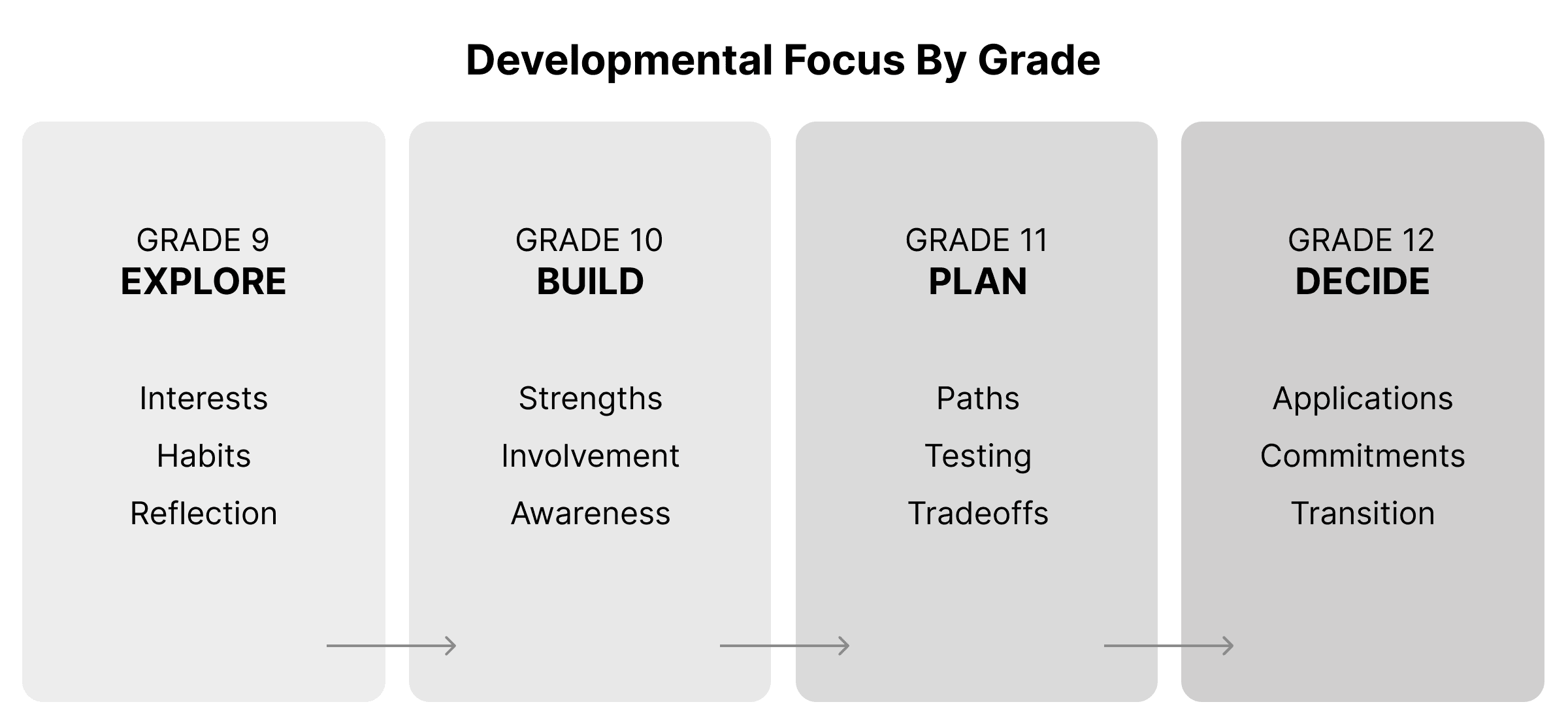
This approach allows students to build self-understanding before being asked to optimize outcomes, and it gives counselors a clearer picture of how student thinking evolves over time.
Deep Dive: Orbital as a Mental Model
Orbital emerged from a failure in linear progress models.
In early prototypes, progress was represented using familiar patterns such as checklists, step-based flows, and timelines. These models implied forward motion toward a fixed end state. They worked well for compliance tasks, but poorly for development.
Students interpreted unfinished or revisited items as falling behind. Returning to earlier milestones felt like regression, even when it reflected healthy reevaluation. This effect was most pronounced for students who were unsure but not struggling. The interface unintentionally added pressure where none was needed.
Orbital reframes progress as movement around a center rather than toward an endpoint. Past, present, and future milestones remain visible at the same time. Revisiting earlier milestones feels expected rather than corrective.
This model communicates that growth is cyclical, reflection is ongoing, and progress does not require constant forward motion. Those ideas align directly with Pathway’s development-first stance.
Orientation is handled implicitly through visual hierarchy rather than instruction. The student’s current context anchors the experience. Past milestones recede without disappearing. Future milestones remain visible without demanding action.
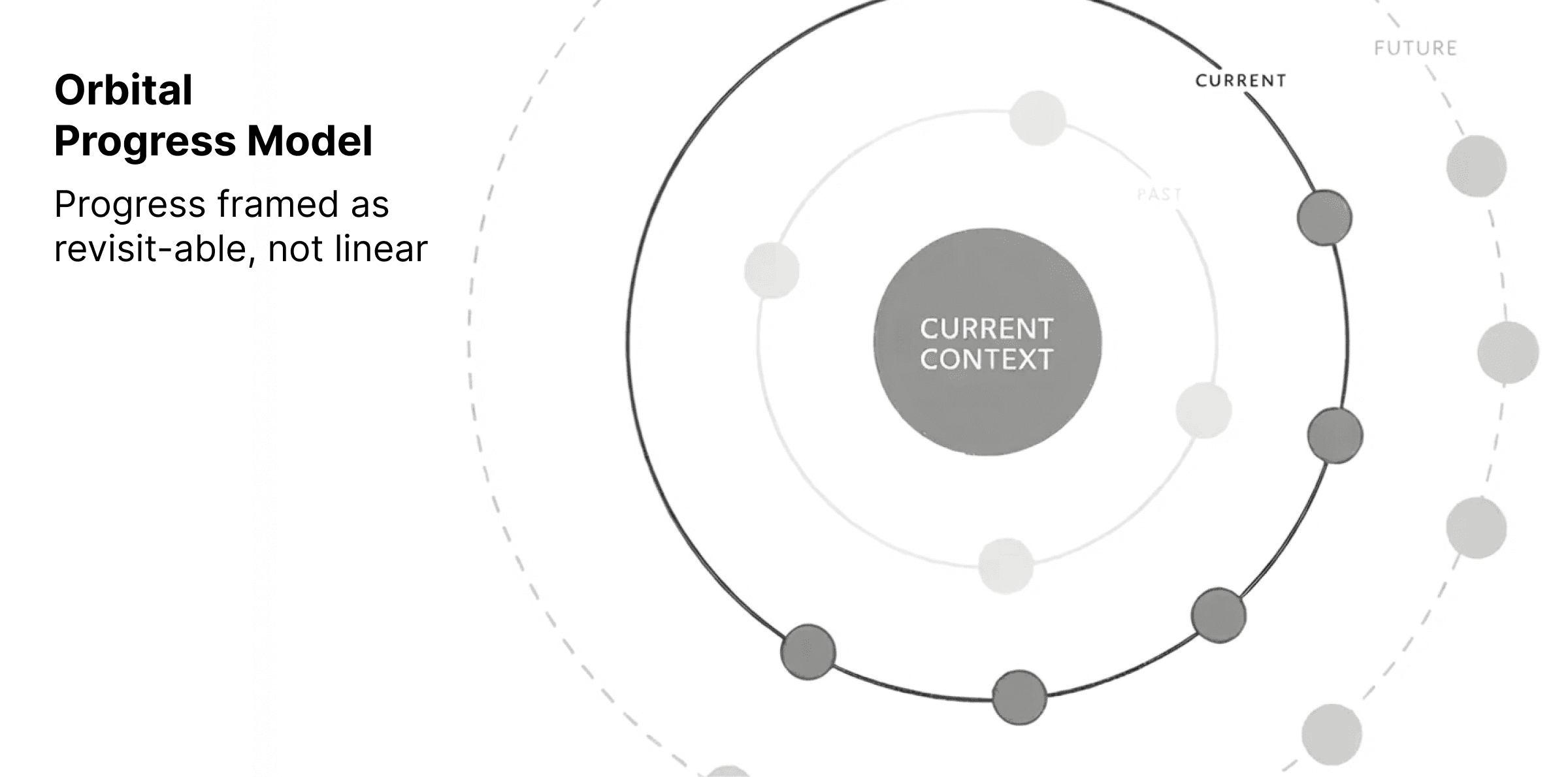
The model communicates that growth is cyclical, uncertainty is normal, and progress does not require constant forward motion. This aligns the interface with the system’s development-first stance.
Deep Dive: AI as a Reasoning Layer
AI in Pathway is intentionally constrained.
Rather than generating recommendations or prescribing paths, the AI operates as a reasoning layer that works only in the presence of student context. Its role is to help students think through their own inputs over time, not to decide on their behalf.
The AI draws from the persistent student profile to surface patterns, reflect prior inputs, and ask clarifying questions. Its behavior changes based on where a student is in their development, avoiding premature guidance or optimization.
This design avoids common failure modes seen in educational AI, including generic advice, overconfidence, and loss of student agency. The system does not rank options, predict outcomes, or suggest “best” paths.
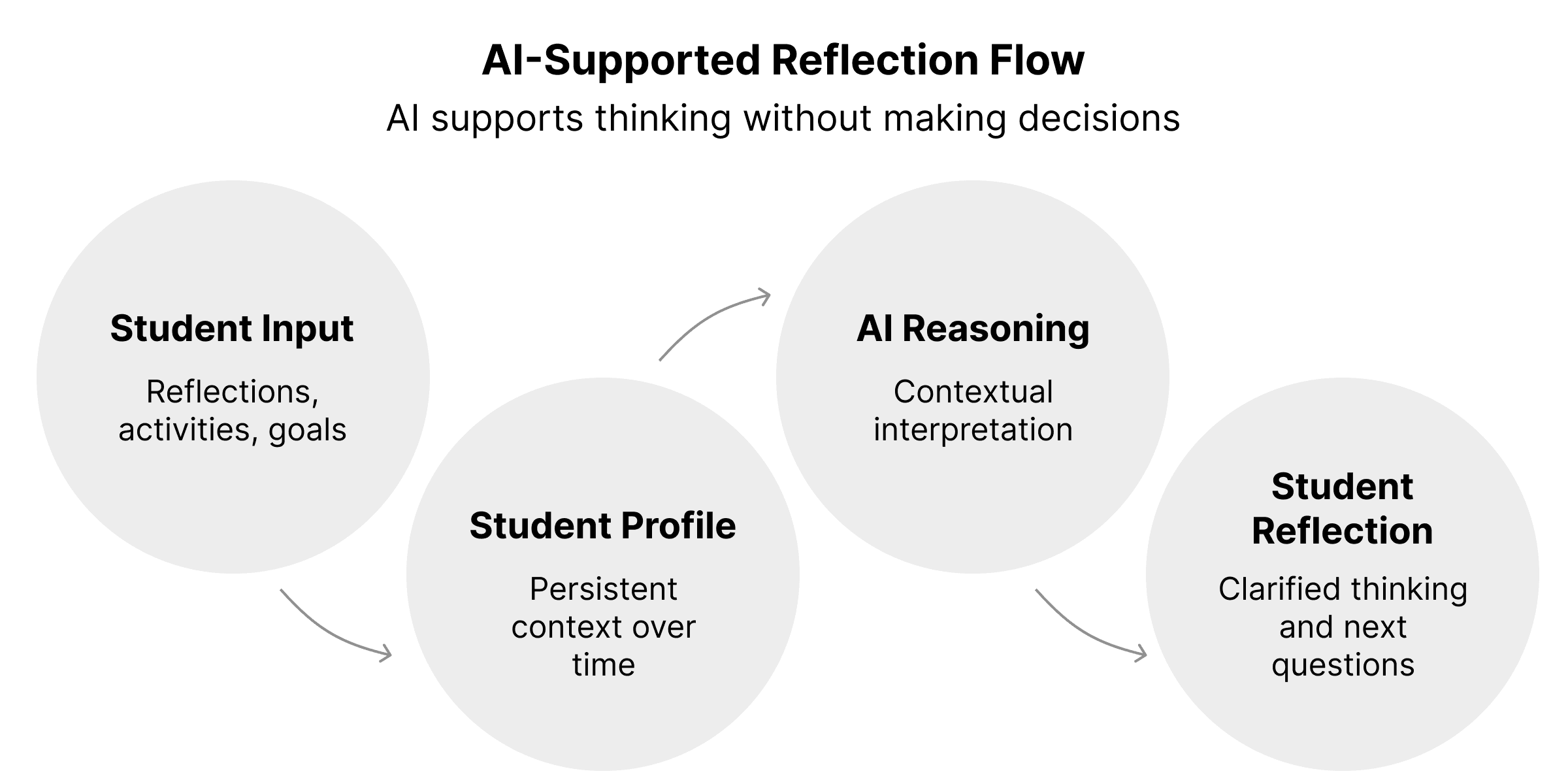
By treating AI as a support for reflection rather than an engine for decisions, Pathway preserves trust with both students and counselors while still reducing cognitive load during moments of uncertainty.
What This Work Validated
Working through Pathway clarified several assumptions about student guidance and where existing systems fall short.
Students engage more readily when reflection happens before stakes appear. Low-pressure prompts around interests, habits, and tradeoffs produced more thoughtful responses than late-stage planning conversations that assume clarity already exists.
Reflection compounds when treated as persistent data. When students could revisit earlier inputs, they began to notice patterns in their own thinking rather than treating each year as a reset. That continuity changed how later decisions were framed and discussed.
Linear progress models introduce unnecessary pressure for students who are unsure but not struggling. Representing growth as revisitable reduced anxiety around “falling behind” and made reevaluation feel normal rather than corrective.
AI earned trust through restraint. When positioned as a reasoning aid rather than an authority, it supported student thinking without displacing counselor judgment or student agency.
Most importantly, guidance breakdowns were less about motivation or effort and more about timing. When support arrives after decisions have already hardened, even good advice feels reactive.
What’s Still Open
Pathway is still an early-stage system, and several questions remain intentionally unresolved.
The right balance between structure and autonomy needs continued testing. Too much structure risks turning reflection into compliance. Too little risks leaving students unsure of how to engage.
Counselor interaction models require further exploration. The system is designed to reduce cognitive load, but how counselors want to enter, interpret, and act on student context varies widely.
Accessibility and cognitive load across different student profiles remain open areas. Orbital performs well conceptually, but it will need testing across diverse learning styles and accessibility needs.
AI boundaries will need ongoing calibration. As context deepens, the line between helpful reflection and unintended influence requires constant attention.
Finally, outcomes must be measured longitudinally. The true impact of early development work only becomes visible years later, which requires patience, iteration, and humility about what can be claimed early.